


Phylum Arthropoda (Arthropods) ➔ Subphylum Hexapoda (Hexapods) ➔ Class Insecta (Insects) ➔ Order Hemiptera (Hemipterans) ➔ Family Miridae (Plant bugs, grass bugs, capsid bugs )
Capsus ater (Linnaeus, 1758)
Schwarzrote Weichwanze
Synonyms and other combinations:
Capsus ater nigripes Tamanini, 1982 | Capsus ater semiflava Servadei, 1972 | Capsus flavicollis (Fabricius, 1775) | Capsus nigricornis Hahn, 1826 | Capsus nigripes (Strobl, 1900) | Capsus rutilus Stichel, 1930 | Capsus semiflavus (Linnaeus, 1767) | Capsus sordens (Gmelin, 1790) | Capsus tyrannus (Fabricius, 1781) | Cimex ater Linnaeus, 1758 | Cimex flavicollis Fabricius, 1775 | Cimex semiflavus Linnaeus, 1767 | Cimex sordens Gmelin, 1790 | Cimex tyrannus tyrannus Fabricius, 1781 | Rhopalotomus ater nigripes Strobl, 1900 |
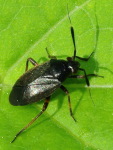
DE, Chemnitz, Zeisigwald
2010-06-13 14:17:32
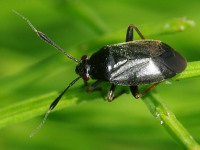
DE, Chemnitz, Zeisigwald
2011-06-25 19:27:53
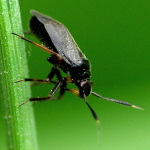
DE, Chemnitz, Hutholz
2010-06-12 12:36:50
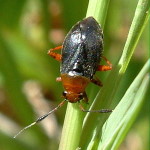 female
DE, Chemnitz
2003-06-14 12:02:27
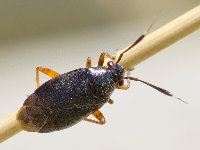
DE, Chemnitz, Hutholz
2018-07-03 13:58:18
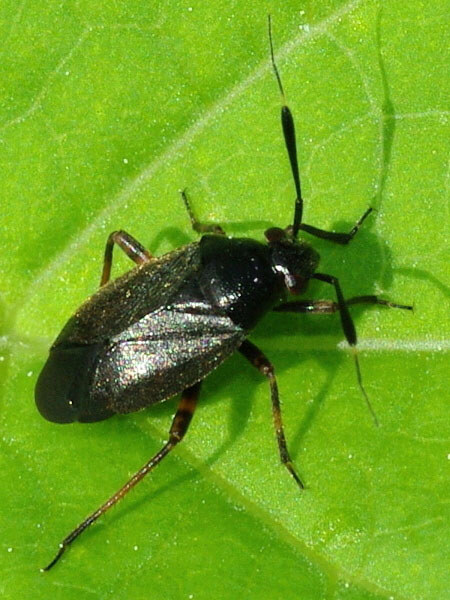
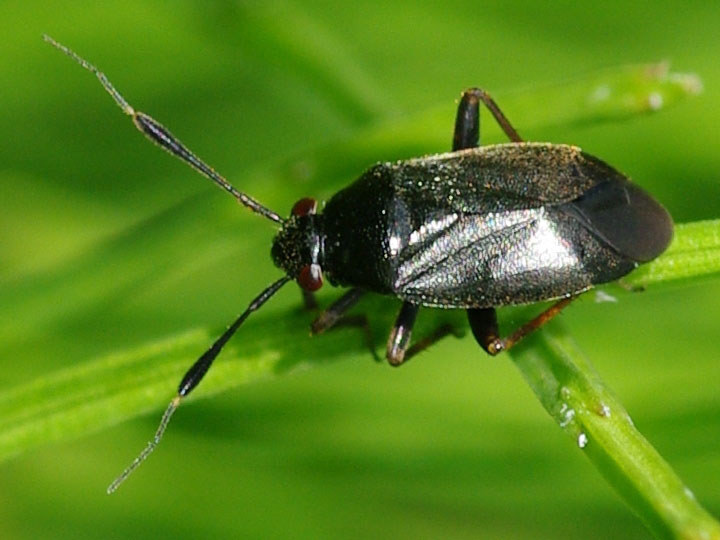
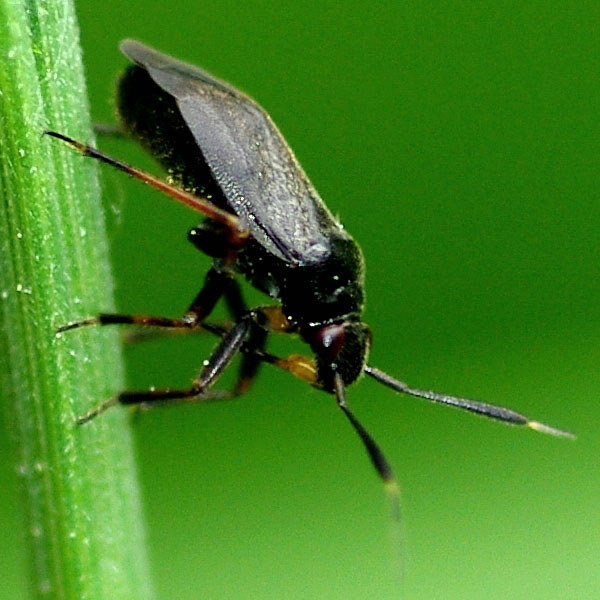

Classification:
Capsus ater belongs to the subfamily Mirinae, tribe Mirini.Distribution:
Europe, North Asia, North Africa, North America.In Germany widespread from lowland to the mountainous area.
Living space:
Dry to moderately humid, open to semi-shady meadows.Description:
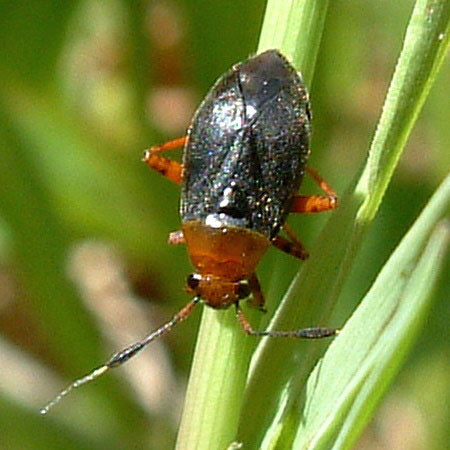
Body length 5,1 - 6,3 mm; oval shape; finely hairy; macropter; forewings and scutellum black; head and pronotum black or rust-brown; legs variable coloured (from black to rust-brown with darker marking); 2. antennal segment club-shaped thickened; 3. antennal segment at the base light.Larvae violet-brown.
Similar species:
Similar, less common species are Capsus pilifer and Capsus wagneri. Male, almost completely black specimens can only be reliably distinguished on the basis of genital anatomical characteristics.Biology:
Capsus ater lives on grasses (Poaceae=Gramineae).After overwintering in egg stage, the larvae of Capsus ater hatch at the end of April/May. The adults appear at the earliest from mid-May, mostly in June, and fly until August. The eggs are deposited by the females into stalks of grass and overwinter.
References, further reading, links:
- Schuh R.T. (2018). PBI Plant Bug: On-line Systematic Catalog of Plant Bugs (Insecta: Heteroptera: Miridae) (version Mar 2013). In: Species 2000 & ITIS Catalogue of Life, 2018 Annual Checklist (Roskov Y., Abucay L., Orrell T., Nicolson D., Bailly N., Kirk P.M., Bourgoin T., DeWalt R.E., Decock W., De Wever A., Nieukerken E. van, Zarucchi J., Penev L., eds.). Digital resource at www.catalogueoflife.org/annual-checklist/2018. Species 2000: Naturalis, Leiden, the Netherlands. ISSN 2405-884X.
- Adelphocoris quadripunctatus
- Adelphocoris seticornis
- Apolygus lucorum
- Calocoris affinis
- Campyloneura virgula
- Capsus ater
- Closterotomus biclavatus
- Closterotomus fulvomaculatus
- Deraeocoris lutescens
- Dicyphus sp.
- Harpocera thoracica
- Heterotoma planicornis
- Lygus pratensis
- Lygus sp.
- Malacocoris chlorizans
- Megacoelum zollikoferiae
- Megaloceroea recticornis
- Miris striatus
- Notostira elongata
- Orthops basalis
- Pantilius tunicatus
- Phylus coryli
- Phytocoris sp.
- Phytocoris varipes
- Pilophorus clavatus
- Plagiognathus arbustorum
- Plagiognathus chrysanthemi
- Psallus betuleti
- Rhabdomiris striatellus
- Stenodema laevigata
- Stenotus binotatus
- Black Kneed Capsid
- Bracken Bug
- Common Nettle Bug
- European Tarnished Plant Bug
- Four-spotted Oak Bug
- Lucerne Bug
- Meadow Plant Bug
- Red Spotted Plant Bug